
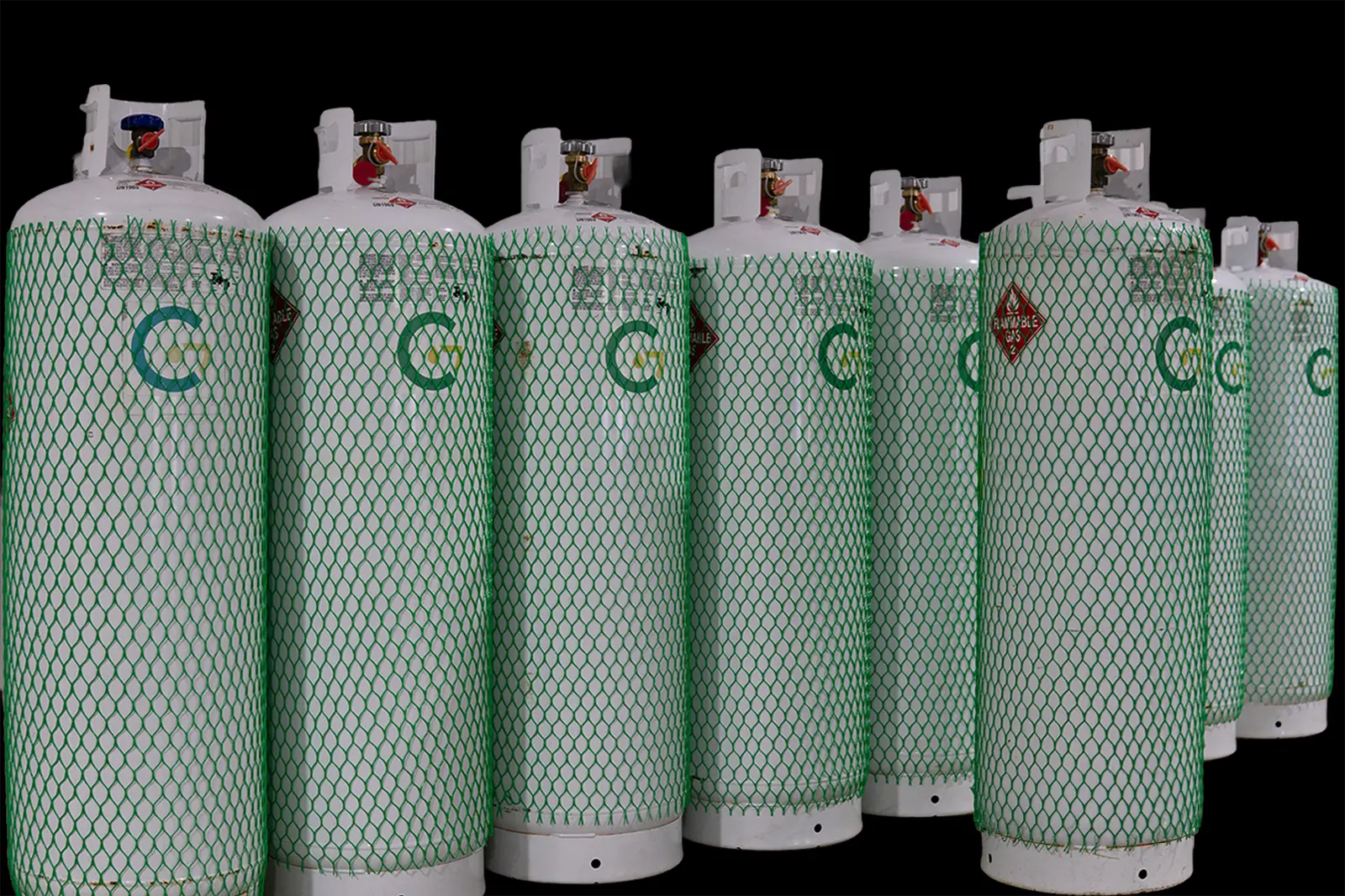
The solvent you load into your column is the single most important upstream decision in a hydrocarbon run. It sets your operating pressure, your recovery speed, how much terpene survives, what color your concentrate finishes at, and ultimately what products you can make. Choosing between hydrocarbon extraction solvents — n-butane, isobutane, propane, or a blend like 70/30 — isn't about which gas is "best." It's about matching the solvent's physical behavior to your biomass, your system, and your target output.
This guide breaks down the four most common options side by side: how each behaves, what it's good at, where it falls short, and how to think about choosing a blend. The differences come down mostly to one property — boiling point — and everything that follows from it.
What Are Hydrocarbon Extraction Solvents?
Hydrocarbon extraction uses light hydrocarbon gases — butane, propane, or both — in liquefied form to dissolve cannabinoids and terpenes out of cannabis or hemp biomass. The process runs in a closed-loop system, a sealed apparatus that pressurizes the gas into a liquid, passes it through the plant material, and then recovers and recondenses the solvent for reuse. Extract made primarily with butane is commonly called BHO (butane hash oil); extract made primarily with propane is called PHO (propane hash oil).
The two terms that drive solvent selection are boiling point and vapor pressure. Boiling point is the temperature at which the liquefied gas wants to return to vapor; vapor pressure is the pressure that gas exerts inside a sealed vessel at a given temperature. A lower boiling point means higher vapor pressure, which means more force inside your system — and a colder, more selective extraction.
Hydrocarbon extraction solvents are light hydrocarbon gases — primarily n-butane, isobutane, and propane — used in liquefied form to dissolve cannabinoids and terpenes from cannabis biomass in a closed-loop system. They differ mainly by boiling point: n-butane boils highest at 31.1°F and runs at the lowest pressure with the highest yield, propane boils lowest at -43.6°F and runs at the highest pressure with strong terpene retention, and isobutane and butane/propane blends sit between the two.
N-Butane: The BHO Industry Standard
N-butane (normal butane, C₄H₁₀) is the default solvent for most hydrocarbon operations. With a boiling point of 31.1°F (-0.5°C), it has the highest boiling point — and therefore the lowest vapor pressure — of the common extraction hydrocarbons. That low pressure makes it forgiving to run and keeps system stress modest.
N-butane offers high solvency, which translates to strong cannabinoid yield and a well-understood evaporation profile that operators have refined over years of use. The trade-off is that its higher boiling point pulls a slightly lower terpene fraction and a darker end color than the colder solvents, and its slower recovery time means longer runs. It remains the workhorse for shatter, wax, badder, and live resin across both small-batch and commercial-scale labs.
Isobutane: The Lower-Boiling Isomer
Isobutane shares n-butane's chemical formula (C₄H₁₀) but is a structural isomer — same atoms, different arrangement, with a branched rather than straight carbon chain. That structural change drops its boiling point to roughly 10.9°F (-11.7°C) and raises its vapor pressure to about 1.5 times that of n-butane.
Practically, isobutane sits in the middle of the pack. It evaporates and recovers faster than n-butane, which shortens purge time in the vacuum oven, and its colder extraction can yield a lighter-colored product while preserving more terpenes. Because it still carries four carbon atoms, it generally holds a higher yield than propane. Operators reach for isobutane on terpene-forward work, on older or lower-grade biomass where it helps avoid pulling dark compounds, and as a component in custom blends.
Propane: High Pressure, Terpene-Forward (PHO)
Propane (C₃H₈) sits at the cold, high-pressure end of the spectrum with a boiling point of -43.6°F (-42°C). That low boiling point means the highest vapor pressure of the group, so propane systems must be rated for and operated at substantially higher pressures.
The payoff for that pressure is a colder, more selective extraction. Propane pulls a more robust terpene profile and leaves behind more of the lipids and waxes that butane would otherwise carry over — which is why propane is favored for high-terpene extracts and sauces. The trade-off is generally lower cannabinoid yield than butane and the equipment and safety demands that come with running at higher pressure. Propane is rarely run entirely on its own for full-spectrum work; more often it's blended with butane to lift pressure and terpene retention while preserving yield.
70/30 Butane/Propane Blend: The Best of Both
The 70/30 n-butane/propane blend — 70% n-butane, 30% propane — is one of the most widely used solvents in the industry, and it's Cannagas Supply's most popular product. It exists because the strengths of each gas offset the other's weaknesses. Adding propane to n-butane raises tank head pressure while keeping the overall boiling point low — around 8°F (-13.3°C) — which produces faster recovery and shorter run times than butane alone, with better terpene preservation and lighter color.
In other words, you get much of n-butane's yield and solvency together with propane's pressure and terpene-forward behavior. That versatility is why the 70/30 blend handles the full range of end products — diamonds, shatter, live resin, badder — without forcing you to commit to a single-gas profile. For many labs it's the practical default when they want one solvent that does most jobs well.
N-Butane vs. Isobutane vs. Propane vs. 70/30: Side by Side
The table below summarizes how the four solvents compare on the properties that matter most when you're dialing in a run. Cylinder fill weights reflect Cannagas Supply's true-spec fills.
| Solvent | Boiling Point | System Pressure | Cannabinoid Yield | Terpene Retention | Typical Products | Cylinder Fill |
|---|---|---|---|---|---|---|
| N-Butane | 31.1°F (-0.5°C) | Lowest | Highest | Moderate | Shatter, wax, badder, live resin | 120 lbs |
| Isobutane | 10.9°F (-11.7°C) | Medium (~1.5× butane) | High | High | Terp-forward concentrates, diamonds, lighter color | 116 lbs |
| Propane | -43.6°F (-42°C) | Highest | Lower | Highest | High-terpene sauce, live resin terps | 100 lbs |
| 70/30 Blend | 8°F (-13.3°C) | Medium–High | High | High (balanced) | Diamonds, shatter, live resin, badder | 114 lbs |
How Do You Choose the Right Hydrocarbon Solvent?
There's no single correct answer — the right solvent depends on what you're making and the system you're running. Work through these factors in order:
- Define your target product first. Yield-driven products like shatter and wax favor n-butane or a butane-heavy blend. Terpene-forward products like sauce and high-terpene extract (HTE) favor propane or a higher-propane blend.
- Check your system's pressure rating. Propane and high-propane blends generate substantially more head pressure than butane. Your closed-loop system, fittings, and recovery setup must be rated for it. Never run a higher-pressure solvent than your equipment is designed to handle.
- Factor in biomass quality. Fresh, high-grade indoor biomass tolerates butane well. Older or lower-grade material often benefits from a colder solvent (isobutane or a blend) that pulls fewer dark compounds, lipids, and waxes.
- Weigh recovery time and throughput. Colder, higher-pressure solvents recover faster and shorten both run and purge times. If throughput is a bottleneck, a blend usually beats straight n-butane.
- Decide whether a blend serves you better than a single gas. Most operators land on a blend because it balances competing priorities. A 70/30 blend is a strong starting point; from there you can adjust the propane fraction up for more terpenes and pressure, or down for more yield.
If you're unsure where to start, run a controlled comparison on a known-weight sample of one biomass lot — straight n-butane versus a 70/30 blend — and evaluate yield, color, and terpene retention against each other. That baseline tells you far more about your specific material and system than any general rule, and it's the fastest way to justify moving to a custom blend.
Why Solvent Purity Matters More Than the Gas You Pick
Whichever solvent you choose, purity is non-negotiable. A hydrocarbon run is only as clean as the gas you put into it — residual impurities in the solvent carry straight through into your extract, where they affect flavor, potency, and compliance test results. The benchmark for extraction-grade hydrocarbons is 99.5% purity or higher, non-odorized (free of the mercaptan added to fuel-grade gas), and BTEX-free — meaning non-detectable levels of benzene, toluene, ethylbenzene, and xylene.
Just as important is documentation. A Certificate of Analysis (COA) verifies the purity spec of the specific product you received, which you'll want on file for QC and state compliance. Cannagas Supply hydrocarbons — n-butane, isobutane, propane, and all blends — are 99.5%+ pure, non-odorized, BTEX-free, and have COAs available upon request for every order.
Safety and Compliance Considerations
All four solvents are flammable, liquefied gases, and propane and high-propane blends carry the added hazard of higher operating pressure. Hydrocarbon extraction is regulated accordingly. Because butane and propane are liquefied petroleum gases (LPG), their storage and handling fall under OSHA 29 CFR 1910.110 — OSHA's LPG-specific standard — rather than the general flammable-liquids rule at 29 CFR 1910.106. Most jurisdictions also require closed-loop hydrocarbon extraction to be performed in a properly classified, often C1D1-rated environment with appropriate ventilation, gas detection, and fire suppression.
- Run extraction only in equipment rated for the solvent's operating pressure, and in a space classified for the hazard.
- Store cylinders upright in a well-ventilated, temperature-controlled area away from ignition sources.
- Maintain gas detection and follow your facility's flammable-gas handling and emergency protocols.
- Keep COA and SDS documentation on file for every solvent lot per your state processor licensing requirements.
Because hydrocarbons are regulated materials, they also ship under DOT hazmat rules — which is its own subject. If you're evaluating suppliers, our breakdown of how hazmat-certified freight works covers what compliant solvent delivery should look like.
Sourcing Hydrocarbon Solvents and Custom Blends
Cannagas Supply stocks n-butane, isobutane, propane, and the popular 70/30 n-butane/propane blend, all at 99.5%+ purity with COAs available upon request for every order. Cylinders are filled to true spec — n-butane at 120 lbs, isobutane at 116 lbs, propane at 100 lbs, and the 70/30 blend at 114 lbs — with no short fills.
If a stock gas or the 70/30 blend doesn't match your process, Cannagas Supply formulates custom 2-part and 3-part blends using n-butane, propane, and isobutane at any ratio. Share your target output, system specs, and biomass type, and the team will build the blend to spec. We supply licensed extraction labs across the U.S., with local delivery in Arizona, California, Nevada, New Mexico, and a dozen additional states plus rapid nationwide hazmat-certified shipping. Once you've cleaned up your run on the front end, the same logic applies downstream — our guide to silica 60A and post-processing filtration media covers polishing crude after the solvent comes off.
Frequently Asked Questions
N-butane and isobutane share the same chemical formula (C₄H₁₀) but differ in structure — isobutane is a branched isomer of n-butane. That difference gives isobutane a lower boiling point of about 10.9°F (-11.7°C) versus n-butane's 31.1°F (-0.5°C), plus roughly 1.5 times the vapor pressure. Isobutane therefore evaporates and recovers faster, runs colder, and can produce a lighter-colored extract, while n-butane offers the highest solvency and yield of the two.
Neither is universally better — they serve different goals. N-butane's higher boiling point (31.1°F), lower pressure, and higher cannabinoid yield make it the standard for shatter, wax, and live resin. Propane boils at -43.6°F, runs at much higher pressure, and extracts a more robust terpene profile while leaving behind more lipids and waxes, but usually returns lower cannabinoid yield. Many operators run a blend to capture both effects.
A 70/30 n-butane/propane blend pairs the yield and solvency of n-butane with the higher pressure and terpene-forward behavior of propane. The propane fraction raises tank pressure while keeping the boiling point low (around 8°F / -13.3°C), supporting faster recovery and run times, better terpene preservation, and lighter color than either gas alone. It's versatile across shatter, badder, diamonds, and live resin, which makes it one of the most widely used solvents in the industry.
Extraction-grade hydrocarbons should be 99.5% purity or higher, non-odorized (no mercaptan), and free of BTEX contaminants — benzene, toluene, ethylbenzene, and xylene. Residual impurities carry directly into the extract and can affect flavor, potency, and compliance testing. Cannagas Supply hydrocarbons are 99.5%+ pure, non-odorized, BTEX-free, with COAs available upon request for every order.
Yes. Cannagas Supply formulates custom 2-part and 3-part blends using n-butane, propane, and isobutane at any ratio your process requires. The right ratio depends on your target output, system pressure rating, and biomass type. Share your goals and the team formulates the blend to spec, supplied at 99.5%+ purity, with COAs available upon request.